☰
Properties of Rational Function and How to Solve Them:

1. Domain - The domains of a rational function are the real numbers except for those that make the denominator zero, thus making the function undefined. This is essential for ensuring that you don’t plot undefined values.
Steps to Find the Domain of a Rational Function:
- Write the rational function.
- Focus on the denominator.
- Set the denominator equal to zero.
- Solve the equation for \(x\).
- Exclude those \(x\)-values from the domain.
- Express the domain in set or interval notation.
2. Range - The range of a rational function is the corresponding set of real numbers once the domain is transformed. Understanding the range helps in determining the behavior of the function for all possible input values and provides a complete picture of the function’s outputs.
To find the range of the function, change \(f(x)\) to \(y\) then solve for \(x\); remember the range consists of real values of \(y\) that will make a real value for the function.
3. Zeroes - When dealing with rational functions, whatever value of \(x\) that will make the numerator zero without simultaneously making the denominator equal to zero will be a zero of the said rational function. These are critical for determining where the function has roots and for understanding the overall shape in graphing.
Steps to Find the Zeroes of a Rational Function:
- Factor the numerator and the denominator of the rational function if possible.
- Identify the restrictions of the rational function. (The restrictions are the values of the independent variable that make the denominator equal to zero.)
- Identify the values of the independent variable that make the numerator equal to zero.
4. Intercepts  - The intercepts of the graph of a rational function are essential for determining the points of intersection of its graph and an axis. Intercepts are \(x\)- and \(y\)-coordinates of the points at which a graph crosses the \(x\)-axis or the \(y\)-axis, respectively.
The \(y\)-intercept is the \(y\)-coordinate of the point where the graph crosses the \(y\)-axis.
The \(y\)-intercept of the graph of a rational function \(r(x)\), if it exists, occurs at \(r(0)\), provided that \(r(x)\) is defined at \(x = 0\).
The \(x\)-intercept is the \(x\)-coordinate of the point where the graph crosses the \(x\)-axis.
The \(x\)-intercept of the graph of a rational function \(r(x)\), if it exists, occurs at the zeros of the numerator that are not zeros of the denominator.
Note: Not all rational functions have both \(x\)- and \(y\)-intercepts.
Steps to Find the Intercepts of a Rational Function:
- \(x\)-Intercept: Set the numerator equal to zero and solve for \(x\).
- \(y\)-Intercept: Substitute \(x = 0\) into the function and simplify to find the value of \(y\).
5. Asymptotes - are a line that a curve approaches as it heads towards infinity but never touches it. An imaginary line to which a graph gets closer and closer as it increases or decreases its value without limit. These are critical for accurately sketching the graph, especially at extreme values of \(x\).
Types of Asymptotes:
- Vertical Asymptote 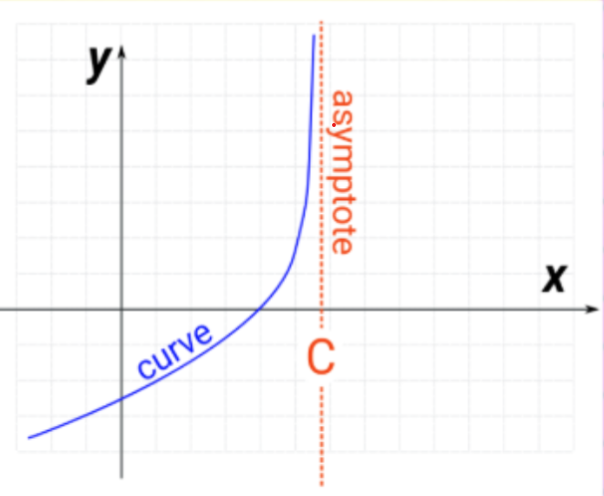 - As \(x\) approaches some constant value \(c\) (from the left to right), then the curve goes towards \(\infty\) (or \(-\infty\)). To determine the vertical asymptote of a rational function, find the zeros of the denominator that are not zeros of the numerator.
- Horizontal Asymptote 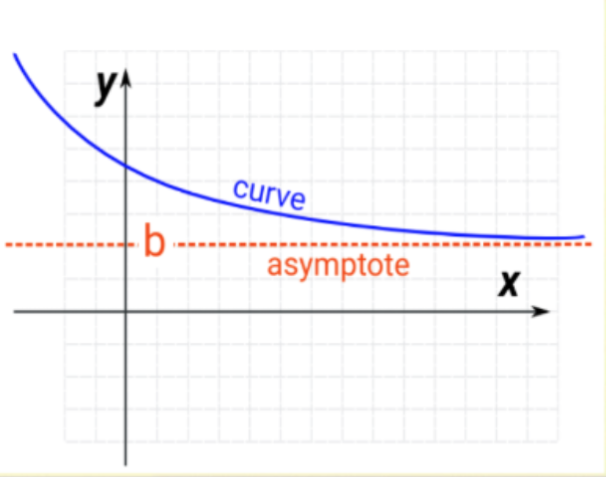 - As \(x\) goes to \(\infty\) (or \(-\infty\)), the curve approaches some constant value \(b\). To determine the horizontal asymptote of a rational function, compare the degree of the numerator \(n\) and the degree of the denominator \(d\).
- Oblique Asymptote 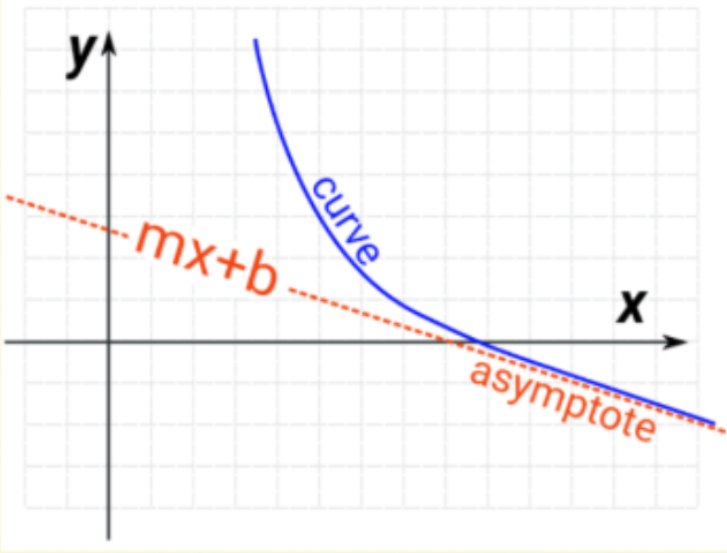 - As \(x\) goes to \(\infty\) (or \(-\infty\)), then the curve goes towards a line \(y = mx + b\). (Note: \(m\) is not zero as that is a horizontal asymptote)
It occurs when the numerator of the function has a degree that is one higher than the degree of the denominator. If you have this situation, simply divide the numerator by the denominator by either using long division or synthetic division. The oblique asymptote is the quotient with the remainder ignored and set equal to \(y\).