☰
Solving Rational Functions According to Calculus
How do we know if a problem is a rational function?
A function is considered a rational function if it can be expressed as the quotient (division) of two polynomials. More specifically, a rational function has the form:
\[
R(x) = \frac{P(x)}{Q(x)}
\]
Where:
P(x) is the numerator polynomial.
Q(x) is the denominator polynomial.
Q(x) \neq 0 (the denominator cannot be zero, as division by zero is undefined).
Steps to Identify a Rational Function
1. Check the Form of the Function: If the function is a ratio of two expressions where both the numerator and the denominator are polynomials, it is a rational function.
2. Confirm Polynomial Structure: Both the numerator \( P(x) \) and denominator \( Q(x) \) should have powers of \( x \) with non-negative integer exponents. Examples of polynomials are \( x^2 + 3x + 2 \), \( 5x^3 - x + 7 \), or even constants like \( 4 \) (which is a polynomial with degree 0). If either part of the expression (numerator or denominator) involves non-polynomial elements such as square roots, trigonometric functions, or logarithms, the function is not a rational function.
3. Check for Division: The function must involve division. If the function involves the multiplication or addition of polynomials like \( P(x) + Q(x) \), it is not a rational function.
4. Avoid Zero in the Denominator: For it to be a valid rational function, the denominator \( Q(x) \) must never be zero, because division by zero is undefined. Therefore, make sure the denominator doesn't introduce any undefined points.
Example #1:
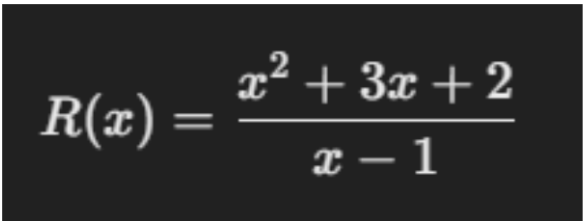
Here, both \(x^2 + 3x + 2\) and \(x - 1\) are polynomials, thus this is a rational function.
Example #2:
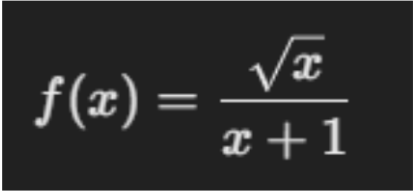
Although this looks like a ratio, the presence of \(\sqrt{x}\) (which is not a polynomial) means that this is not a rational function.
Example #3:
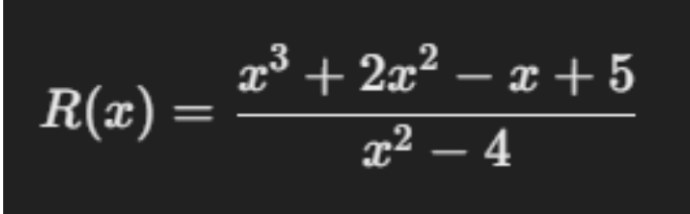
Both the numerator and denominator are polynomials, thus this is a rational function.
Example #4:
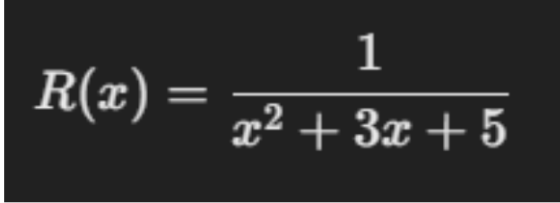
This is still a rational function because the numerator (number 1, which is a constant) is considered a polynomial, and it is in the form of a ratio of polynomials.
Example #5:
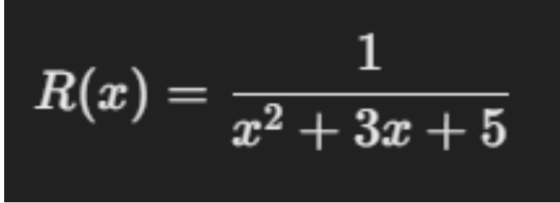
The numerator \(e^x\) is an exponential function, not a polynomial. Hence, this is not a rational function.
Example #6:
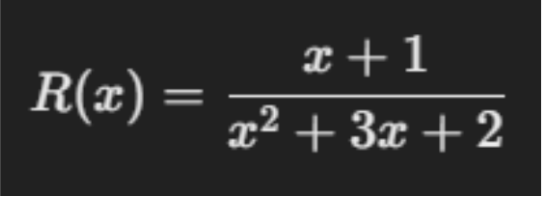
This is a rational function because both the numerator and denominator are polynomials.
Example #7:
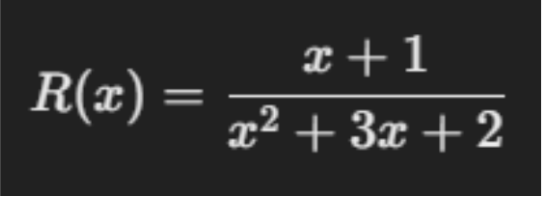
The denominator involves \(\sin(x)\), which is a trigonometric function, not a polynomial. So, this is not a rational function.
Example #8:
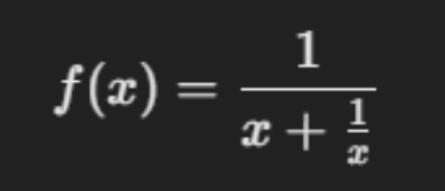
The denominator contains a fraction \(\frac{1}{x}\), and this makes the denominator not a polynomial. Thus, this is not a rational function.
Example #9:
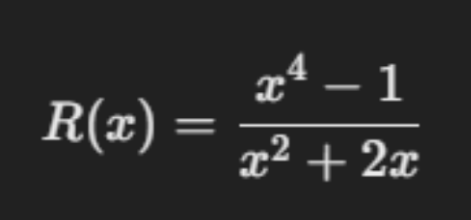
This is a rational function because both the numerator and denominator are polynomials.
Example #10:
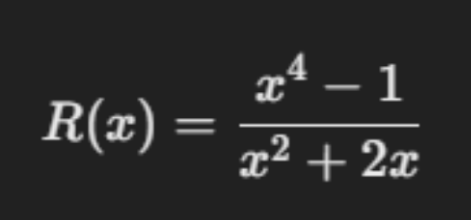
The numerator \(\log(x)\) is not a polynomial, as logarithmic functions are not polynomials. Therefore, this is not a rational function.
Summary of Examples
Rational Functions: They are always the ratio of two polynomials, where the numerator and denominator are algebraic expressions involving non-negative integer powers of \(x\).
Non-Rational Functions: These include functions involving square roots, logarithms, trigonometric functions, or exponentials that are not polynomials.